


“I need to get quieter before I can see this.”
“When I’m in a better place, it’ll land.”
“I’m too far down for any of that right now.”
Almost everyone who reads about the inner life carries one of these, and almost nobody says it out loud, because it does not feel like a belief. It feels like a fact about how the thing works. First you feel better. Then you see. In that order, always.
If that is the rule you have been living by, you have not been doing anything wrong. It is what you would conclude from nearly everything that has ever been said to you about this, including some of what I have said. And it is not how insight works. It never was.
Where the rule comes from
It is not made up. There is something real underneath it.
A quiet mind does hear more. When the noise drops, more arrives, and anyone who has had a single clear morning after a bad month knows it. So teachers teach from there. They describe the principles from the calm, the ease, the good feeling, because that is where the seeing happens most, and the description is accurate.
But look at what it does to the person listening who is not calm.
They hear an accurate description of a place they are not in, and they turn it into a route. Get to the good feeling, and then the insight will be available to you. Nobody said that. The teacher may have said the opposite in the next sentence. It does not matter, because the window the teaching came through was a window, and a person outside it will always hear a window as a door they have to reach.
I did this for years, working my way toward the state from which the seeing was supposed to happen, and then arriving there tired, and then waiting.
What the record says
Here is the thing that undid it for me, and it is not a teaching. It is a look at the record.
Think back over every real insight you have ever had. Not the pleasant thoughts, the ones that changed something. The moment in the argument when you suddenly saw what you were doing. The morning after the diagnosis when something in you went still. The sentence in a book that you had read four times before and that only landed on the fifth, in a week when nothing was going well.
Now put each of them on a scale from the worst you have ever felt to the best.
They are all over it. Some came on good days. Some came at the bottom, in the middle of the night, with the chest tight, in the exact state the rule says nothing can arrive in. And there were good days, plenty of them, weeks of good feeling, when nothing arrived at all.
Insight has never once checked how you were feeling before it arrived.
That is not an argument. It is your own history, and you can go and look at it in the next minute.
Two different axes
So why does the rule feel so true if the record says otherwise?
Because feeling and insight are not on the same line, and the rule assumes they are.
A feeling is a finished thing. By the time you can feel it, it has already been generated, whole, through Thought, and what you are holding is the result. Low or high, tight or open, it is Reality, complete, made the only way anything is ever made. You can move along that scale all day. You can get better at moving along it. You will be moving along a line of finished products.
Insight is not on that line. It is not a very good feeling. It is the moment the source of the feeling is seen, which happens before the feeling, in the place feelings are made from, and no amount of travelling along the results ever arrives there. You cannot reach the projector by walking further along the screen.
Which is why the graph looks the way it does. Insight lands at every point on the feeling scale, because it does not come from the feeling scale. It comes from underneath it, and underneath is the same distance from everywhere.
Up and in
There is a line of Sydney Banks’s that gets quoted at people in difficulty more than any other: look for a good feeling. It has sent a great many of them up the scale.
I think it means something else, and the difference is the whole piece.
A good feeling can mean a better one. Higher on the scale, calmer, warmer, nearer the window. That reading gives you a ladder with a thousand steps and no top, and it puts the seeing somewhere above you.
Or a good feeling can mean an inside one. Not a better product but a different direction. Instead of asking how high you are, asking where this is coming from. Instead of climbing toward the state, turning toward the source, which is exactly as close from the bottom step as from the top, because it is not on the staircase.
Up has a thousand steps. In has none.
That is a smaller move than it sounds, and a stranger one. You do not have to feel any different to make it. You can be at the worst point of the worst week and turn toward where the week is being made, and there is nothing in the way, because there was never a step to take.
You are not behind
You are fine where you are.
That is a fact about the machinery, not a kindness: the low feeling you are in is the same three Principles working, at full fidelity, and the place insight comes from has not moved an inch away from you because of it. Nobody outside the window was ever behind. They were only ever looking at the window from the wrong side of a description.
And the person who taught you otherwise was not lying. They were describing where it happens most, and you did the rest, the way anyone would.
What this is not
None of this says stay low. If a way up presents itself, take it, and be glad. The claim is only that the way up and the way in are two different directions, and that the second one was never waiting on the first.
And turning in is not a technique either. The moment it becomes a thing you do in order to get an insight, you have built a new step and put it at the bottom of the same staircase. It is closer to noticing than to doing. Nobody can hand it to you, and nobody, including you, can make it happen by arranging the feeling first.
So the next time the sentence arrives, and it will, I need to be in a better place before I can see this, you might notice something about it.
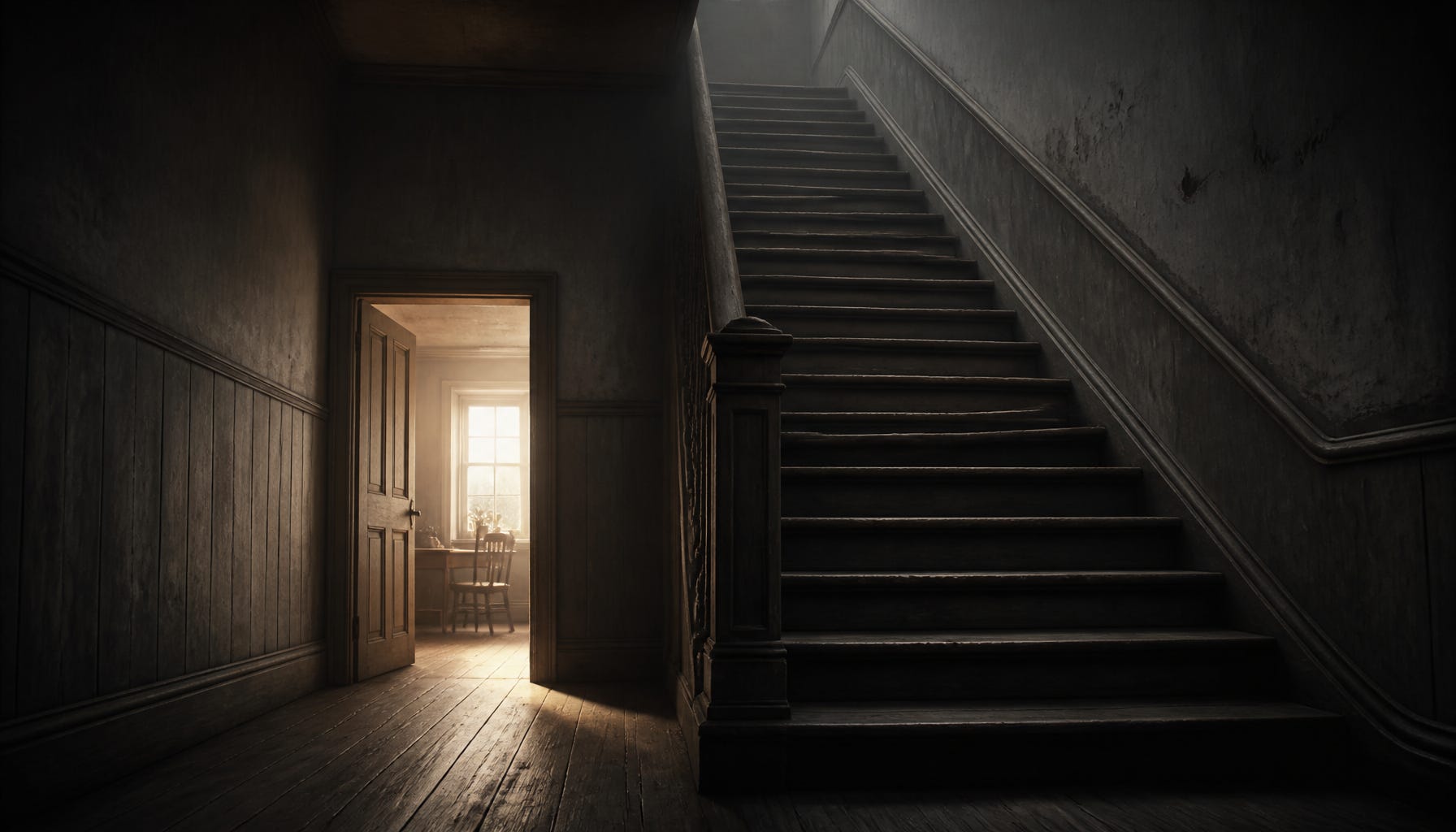
It is a thought about a staircase. And the thing you were waiting to see has never once been up the stairs.
It was never a reward. It is where you already are, at every point on the scale, looking the other way.
🔗 Ask an AI to explain this article: ChatGPT · Claude · Gemini · Perplexity
The graph of insight against feeling, and the two directions hiding inside “look for a good feeling”, came to me through Brett Chitty’s whiteboards. Whatever you saw here, you saw.
One more thing. The book this comes out of is Reality Is an Inside Job, and a short free one sits next to it at insidejob.one. Neither asks you to feel better first.
Quick note: RealityOS is the book’s companion, running inside Claude, for the week you are sure you are too far down for any of this. It is part of the paid subscription, here.
The ChatGPT analysis of this article is a great one (although longer than the article itself 😁)
If you want to dive deeper, here’s the link: https://mdto.page/atmos-black/w4me