


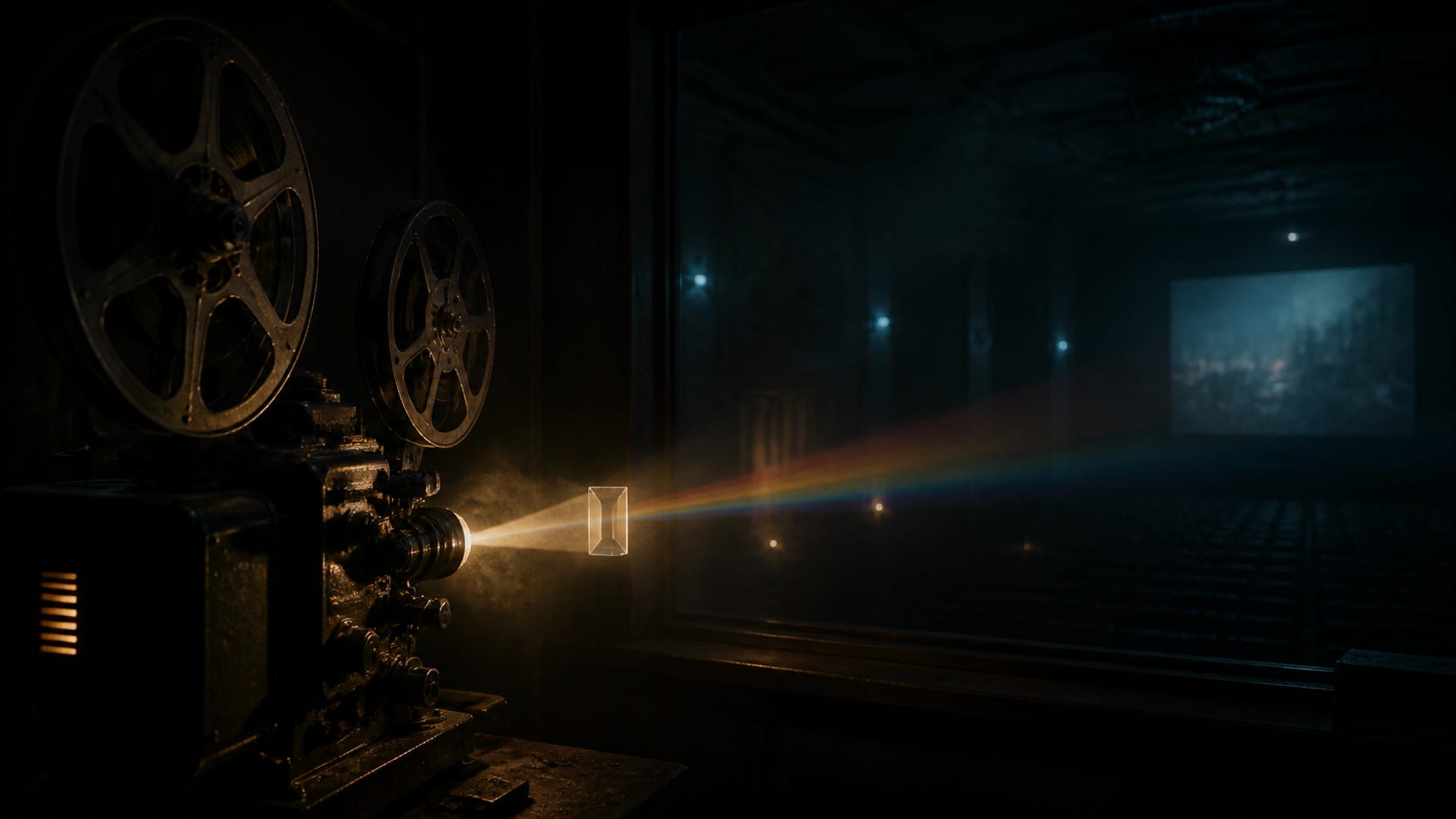
You are watching a film. Something happens on screen and your chest tightens, and for a moment there is no distance at all between you and what is in front of you.
The machine producing every bit of it is behind your head. You never turn around. Not once, in two hours, does it occur to you that the thing you are having a reaction to is a beam of light being thrown across a room by a mechanism you have your back to.
That is not a fact about cinemas. That is the position you are in right now.
Everything you have ever tried to change about your life has been changes to what is on the screen. Everything the self-improvement industry sells operates on what is on the film. The machine has never once been the subject of the work, which is inconvenient, because the machine is the only thing in the room actually producing anything.
I want to lay the whole apparatus out, because it is the cleanest picture of the mechanism I have found, and because there is one part of it that gets mistaken for another part almost universally. That single confusion is the difference between a decade of sincere work that never finishes and a shift that happens in an afternoon and does not need maintaining.
The lamp
Start at the back of the room, with the light.
The lamp has no picture in it. There is no image inside a bulb. It is undifferentiated, featureless, and it is the precondition for anything appearing at all. Without it there is a reel and a lens and a screen and nothing to see.
This is what I call Cosmic Intelligence, and I mean something specific and unromantic by it. Universal intelligence, formless, prior to any particular content, identical in every human being who has ever lived. Not a resource you build. Not something advanced people have more of. The same lamp is burning in the person who has never heard a word of this as in the person who has spent thirty years on a cushion.
You did not install it and you cannot improve it. Its brightness is not a reflection of your progress.
The film
Then there is the material that crosses in front of the light.
This is where most people locate everything, so it is worth being careful. The film is content. It is the specific stuff — the memory, the story about your father, the belief about money, the thing you said in 2011 that still makes you wince, the plan for next year. All of it is material, and material comes from one of two places.
Some of it is fresh. It arrives from the Unknown, unbidden, and it has that quality you recognize immediately when it happens, the sense of something arriving rather than something assembled. I have written elsewhere about why only one of the two paradigms has anywhere fresh to draw from.
Most of it is recycled. It comes out of the closed loop of your own thinking, feeding on itself, producing variations on what it has already produced. This is the loop underneath why changing your thoughts doesn’t work — not because the technique is poor, but because editing one frame of recycled film and putting it back into the same loop is not a structural act.
Two feeds. One machine. That distinction matters enormously for the texture of a life, and it matters not at all to the machine itself, which brings me to the part people get wrong.
The projector
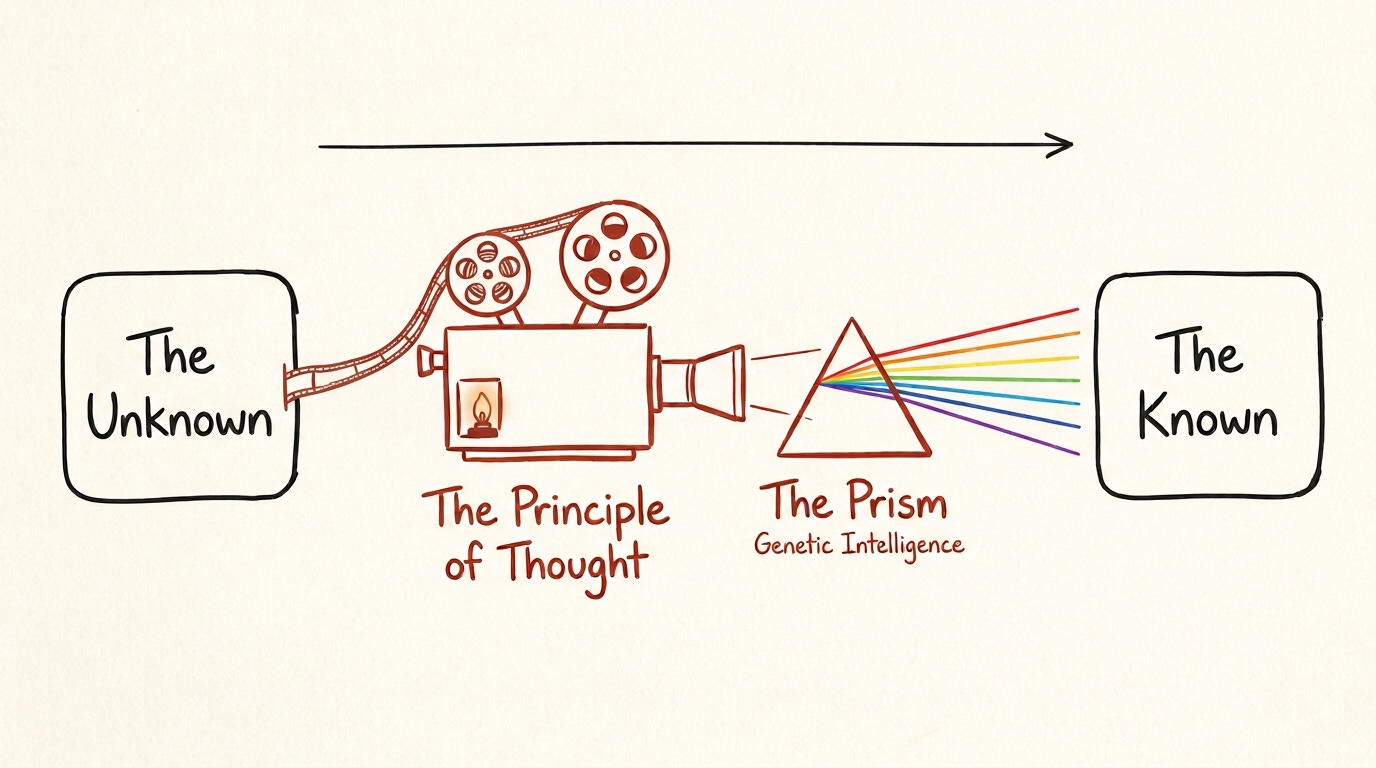
The mechanism is the Principle of Thought.
Not a thought. The Principle of Thought. The operation by which anything whatsoever becomes an experience you are inside of. It is running right now, converting these sentences into something that feels like meaning arriving in a mind. It was running through the worst week of your life and it is running while you sleep.
It is neutral in the way a principle is neutral, which is to say absolutely. It does not evaluate the film. It does not check whether the material is accurate, or healthy, or well-processed, or spiritually mature. It has no opinion about the content and no stake in the outcome.
Give it distorted material and it produces a completely convincing experience of distortion. Give it a beautifully reframed, therapeutically excellent piece of material and it produces a completely convincing experience of that instead. Same fidelity. Same total immersion. Same machine.
It does not care what goes into it. That is not a defect. That is the entire reason it is a principle rather than a personality.
The lens
Here is the part of the apparatus that is mine, and the part I think completes the picture.
A projector does not throw an undifferentiated beam. The light passes through a lens on the way out, and the lens determines the shape of what lands.
That lens is the prism. It is what I call Genetic Intelligence — the specific optical geometry of this particular human being. Same lamp, same neutral mechanism, and yet what arrives on your screen has never once been identical to what arrives on anyone else’s, even when you were both standing in the same room watching the same thing happen.
The Gene Keys, in the way I use them, are a description of the geometry of that lens. Not a personality inventory and not a set of problems to work through. The architecture of the refraction.
And this is where I part company with almost every framework that has ever described this territory: the lens is not a distortion. It is not interference between you and the truth. It is not the ego smudging the pure signal, and there is nothing to polish away.
Universal intelligence has to become someone’s in order to be lived at all. The lens is what makes that possible. Same light, refracted into this specific spectrum, arriving as a specific life. Spend years trying to grind your lens flat so the light comes through unrefracted and you have misunderstood what a lens is for. It is doing exactly what it is supposed to do.
This is the geometry the book I am writing is built on, and it is the chapter I have rewritten the most.
The geometry is not mine. It comes out of the Three Principles, uncovered by Sydney Banks in 1974, and I avoided using the name for longer than I should have.
The screen and the room
What lands is Reality. Lived, felt, immersive, entirely convincing, arriving continuously.
And the whole apparatus — lamp, film, mechanism, lens, screen — is inside a single room. There is no outside to it. No part of this arrives from beyond the walls, which is the thing I have written about at length elsewhere and still consider the strangest true thing I know. The traffic, the weather, the person who ruined your morning: every bit of your experience of them is being produced in here, by this machine, moment by moment.
The film is not showing you the room. The film is the room.
The confusion that costs people years
Now the correction, which is the reason I wanted to write this at all.
Almost everyone who arrives at this understanding makes the film into the projector.
They hear that thought creates experience and they conclude, reasonably, that their thoughts are creating their life. So they go to work on their thoughts. They watch them, catch them, question them, name the story, notice the belief, hold it more lightly. The vocabulary becomes noticeably more spiritual and the activity does not change at all. It is still frame-by-frame work on the reel, performed by someone who is now certain they have located the mechanism. This is the most sophisticated form the misunderstanding takes, and it is the one I find hardest to catch in myself.
They have located the material and called it the mechanism.
A personal thought is film. The Principle of Thought is the machine. These are not two words for one thing and they are not two degrees of the same thing. One is content that has already crossed. The other is the operation that does the crossing, and it is impersonal, constant, and identical in everyone.
I spent a long time on the wrong side of this, doing excellent work on my own material and finding that the work never finished. It never finished because nothing I was doing had gone anywhere near the thing producing the material.
What follows if you actually see it
Three things, and none of them are techniques.
Nothing has ever been broken. The machine was running perfectly through every period of your life you would rather not revisit. That period was not evidence of malfunction. It was a neutral mechanism faithfully producing a completely convincing experience out of whatever was crossing it. There is no repair to perform on a principle.
The lens is not your problem either. Whatever you have been treating as the flaw in how you are built — too sensitive, too intense, too much, too slow to arrive at things — is the geometry of the refraction, not damage to it.
And the move is not better film.
That is where this metaphor wants to take you, and it is the last trap in it. If the projector plays whatever it is given, then obviously the answer is to load better reels, and you can lose another decade there with a cleaner vocabulary. Selecting superior material is still material-level activity. It is the same job with a better job title.
What changes things is seeing that there is a machine at all. That what you have been treating as your situation is something being produced, right now, continuously, by an operation you did not install, refracted through a lens you did not choose, landing on a screen you have never once been outside of.
That seeing is not a practice and it does not accumulate. It happens or it doesn’t. When it happens, the entire relationship to the film reorganizes without a single frame being edited.
Turn around in the cinema and there is not much to see. A beam of light, some dust in it, a machine doing what it has always done.
But you cannot watch the film the same way afterwards.
The projector was never the problem. It was never yours to fix.
The projector image came out of Brett Chitty’s whiteboard, and I am grateful for it — he draws the mechanism more cleanly than anyone I know. The lens is my own addition, and any errors in the extension are mine. Brett credits Keith and Valda for much of the ground underneath all of this. Whatever you saw here, you saw.
Quick note: the apparatus in this article is what RealityOS was built to make visible in your own situations rather than in the abstract — a recognition companion running on your own Claude here.
Reality Is an Inside Job is out now, as ebook, paperback and audiobook. Thirteen short chapters on one sentence. insidejob.one/book →
🔗 Ask an AI to explain this article: ChatGPT · Claude · Gemini · Perplexity