


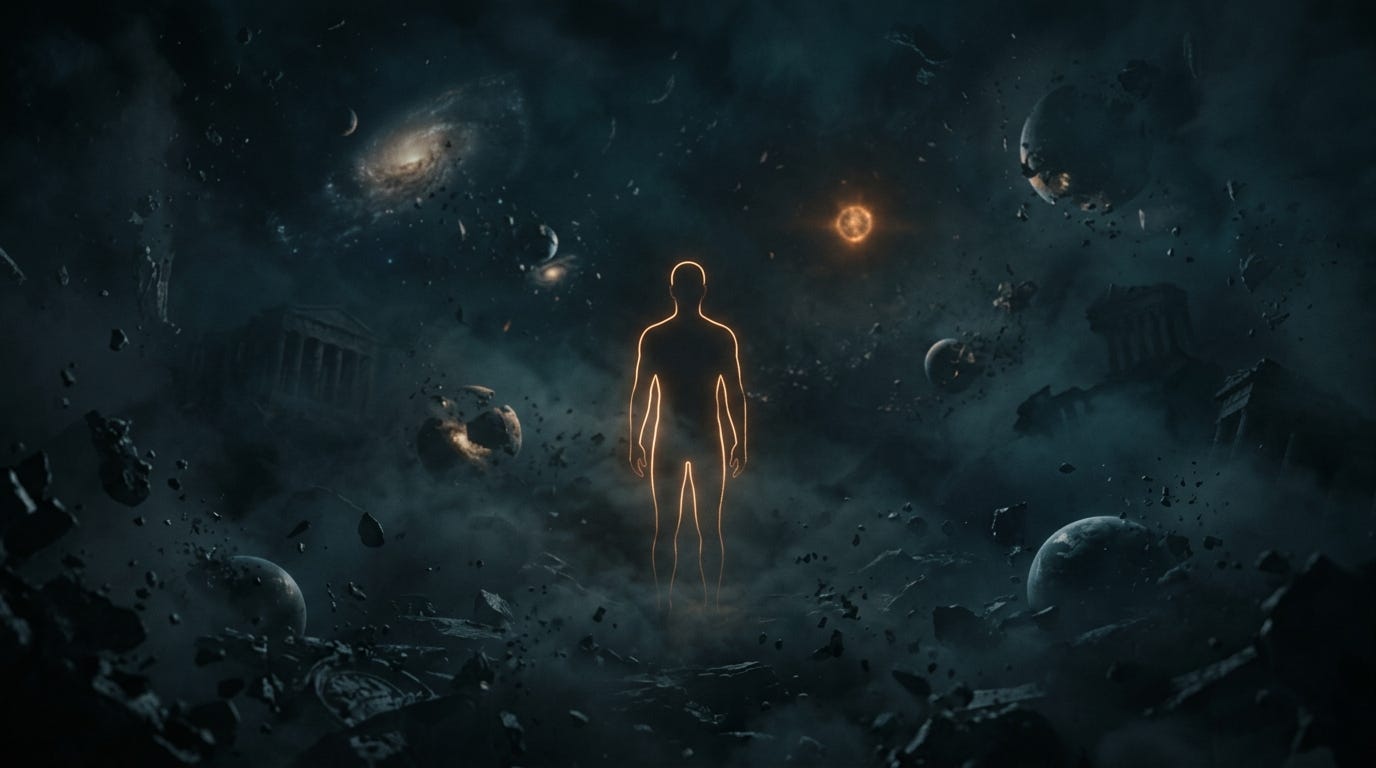
There’s a particular feeling that comes from watching someone brilliant dismantle the very thing you also wanted dismantled, and finding yourself nodding right up until the moment you stop.
Faggin invented the microprocessor. He spends the better part of two hours taking apart the idea that matter is the ground of anything. Spacetime is not fundamental. Matter is not where reality lives. In his phrase, spacetime and matter are the permanent memory of a self-knowing universe. The physical world is the record. Not the source.
Half of me was home. The other half had already left the room.
Here’s the thing worth slowing down for. Demoting matter feels like the radical move. It isn’t. It’s the easy half.
Because the question that decides everything isn’t whether matter is fundamental. It’s what you reach for the instant you decide it isn’t. And almost everyone reaches for the same thing.
A self.
The bigger self
In Faggin’s telling, what we really are is a “seity” — a field of consciousness with free will. The ego, the part that takes itself to be the body, is a kind of servant of this vaster self. Underneath the small self there is a larger one. And underneath all the larger ones, the largest: the One, knowing itself, bringing what it knows into existence as it goes. Spacetime is the memory of that self-knowing. The universe is consciousness speaking to itself.
It’s elegant. It’s sincere. The man had a genuine experience and has spent twenty years trying to give it a rigorous shape.
And it keeps the one thing the whole move was supposed to question.
Watch what happened. The floor got pulled up. Matter stopped being the ground. The ceiling got built higher. We went from being a small self inside a physical world to being a vast self inside a conscious one. The location changed. The furniture changed. The “I” at the centre of it never moved. It only got bigger.
And a bigger self is still a self.
The self that seems to be a person and the self that feels like infinite consciousness are the same move in two sizes. Swapping the small one for the cosmic one feels like awakening. Structurally, nothing has been seen through. The centre is still occupied. Someone is still home, just in a much larger house.
The inside-out paradigm (being non-dual in my view) doesn’t hand you a better self. It doesn’t relocate you into a grander identity. It points at something quieter and harder to hold: that the “I” doing the relocating was never there to begin with. The small self and the cosmic Self are equally empty. There is experience, generated now, through Thought. There isn’t, in addition to it, someone it is all happening to.
That’s the cut Faggin doesn’t make. He takes away the entire universe and leaves a knower standing in the wreckage, asking to be known.
The hard drive
You can watch the same thing happen with time.
Faggin says, cleanly, there is no past. And then he stores it. The fleeting present, he says, has to be written into permanent memory — spacetime, matter, perhaps dark matter, a kind of cosmic hard drive holding every experience the One has ever had. The past is abolished as a word and reinstalled as storage.
But if there is no past, there is nothing to store. Reality is being generated now, through Thought. Then it’s gone. Then it’s generated again. Nothing is accumulating anywhere. There is no library.
The need for a permanent record is the need of a self that wants to have been. A self that requires continuity in order to keep being someone. Drop the self, and the hard drive has nothing left to do.
The floor in the basement
There’s one more place the seam shows.
Asked where the self-knowing comes from, Faggin reaches for the quantum vacuum — the seething emptiness of physics, dense with energy, throwing up form. The formless ground, located in a feature of the physical model.
But the quantum vacuum sits in the Physical. And the Physical and Reality are two different dimensions: the Physical is real in its own right, measurable, indifferent, and simply not where Reality is generated. The moment the formless gets identified with a physical object, however refined the physics, the ground has quietly gone back into matter. The one thing the theory set out to demote.
Pull the floor up at the top and it comes back through the basement.
So this is why a piece like Faggin’s can feel half-home and half-foreign in the same breath. He is right where he points away from matter. He drifts the moment he points toward a Self, a story, a record, a physical home for the formless. The nodding and the refusing aren’t a contradiction in you. They are tracking two different paradigms doing two different things inside one conversation — inside-out language built on a frame that was never dropped, only here reaching all the way up to the cosmos.
Demoting matter was never the hard part. Plenty of brilliant people get there.
The hard part is the one that’s left standing when the universe is gone.
And it was never there.
Here is the video that inspired this article: